
The H2 Poseidon Pipeline
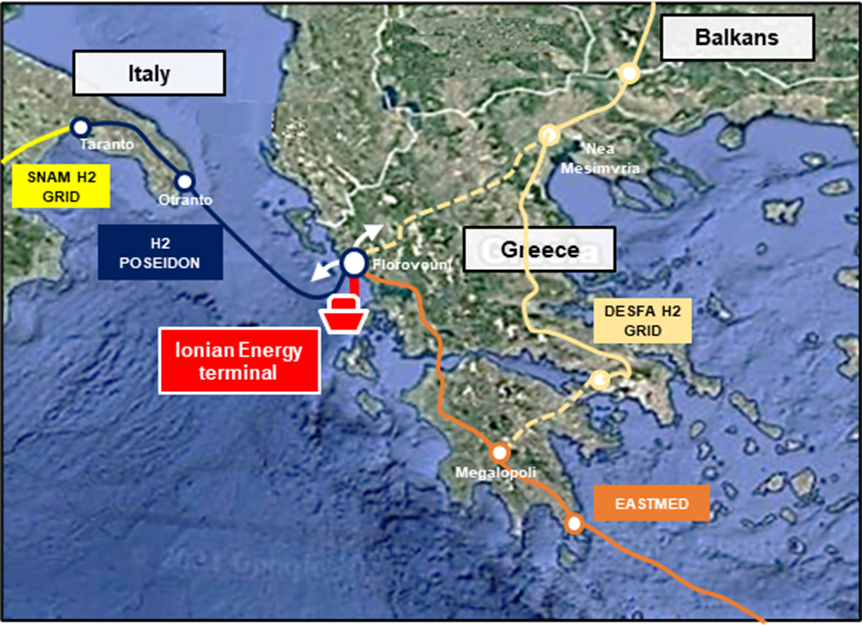
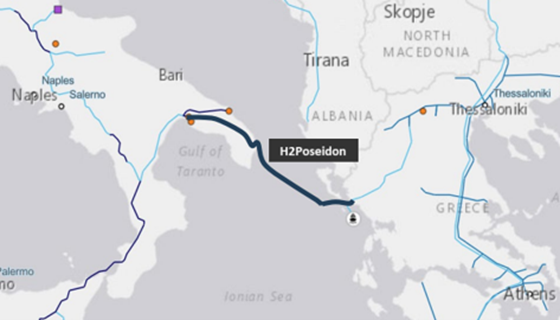
The H2Poseidon Pipeline constitutes a pioneering, bi-directional 100% hydrogen (H2) interconnection between Greece and Italy. It was designed from the outset as a dedicated infrastructure for the transport of pure hydrogen, in full compliance with the new European Union regulation. The project has a total length of approximately 370 kilometers, consisting of a ~210 km offshore pipeline crossing the Ionian Sea – from the region of Igoumenitsa to the landfall point in Otranto, Italy – and a ~160 km onshore pipeline from Otranto to the interconnection point with the Italian H2 transmission system operator (TSO) in the region of Taranto.
The pipeline’s capacity is projected to initially reach 90 GWh/day from 2035 as ramp-up phase capacity, with the objective of reaching 150 GWh/day from 2036 as base capacity. H2Poseidon will operate fully interconnected with the future Greek H2 grid, the Italian H2 Backbone, the Ionian Energy Terminal, as well as the EastMed pipeline, once the latter is converted to a hydrogen carrier. In this manner, it will leverage multiple supply sources, including the domestic production of green hydrogen from Renewable Energy Sources (RES) in Greece, imports from international suppliers via vessels at the Ionian Energy Terminal, and transport from hydrogen production basins in the Mediterranean and the Middle East via the EastMed pipeline.
The H2Poseidon project holds pivotal strategic importance for Europe, as it enhances security of supply and energy diversification. It provides the EU with access to new import routes and integrates the Greek and Italian hydrogen markets, connecting the future networks of DESFA and Snam. Concurrently, it develops the Greece–Italy Hydrogen Corridor toward the major demand centers of Central Europe, supporting the two central South-to-North H2 backbones. Furthermore, it contributes decisively to the decarbonization of hard-to-abate sectors, supplying clean energy to the steel industry in Taranto, as well as to maritime and port activities in Igoumenitsa. The bi-directional flow capability, combined with the storage capacity of the Ionian Energy Terminal, ensures the balancing of the energy system.
The strategic value of the project is reflected in its broad recognition at the European level. The H2Poseidon pipeline is already included in the ENTSOG 2024 TYNDP (Ten-Year Network Development Plan) List and has been confirmed in the 2026 TYNDP List. In addition, it has been included in the 2nd EU Projects of Common Interest (PCI) List for hydrogen, fully satisfying the strict criteria under Article 4 of Regulation (EU) 2022/869.
